

UX Lead
Players and developers have distinct goals and needs, and Riot had a player facing system, but not one for internal tooling. A unified tooling design system could streamline development, ensure consistency across teams, reduce technical debt and reliance on external frameworks.
Additionally, alignment at large companies can be a challenge. Even more so when individual teams don't always know what other teams are building, what problems are being solved, or the individual nuances involved with each solution required.
Cross-org design alignment isn't just about swapping out the color of one button for another, it involves:
Planning time on the roadmap to deprecate the old and implement the new.
Making sure the solution for one team can meet the needs of another.
Identifying individual needs, and then addressing them appropriately with one off solutions that align with the current process, or migrating teams to a shared and aligned solution.
Onboarding teams and users to the new processes.
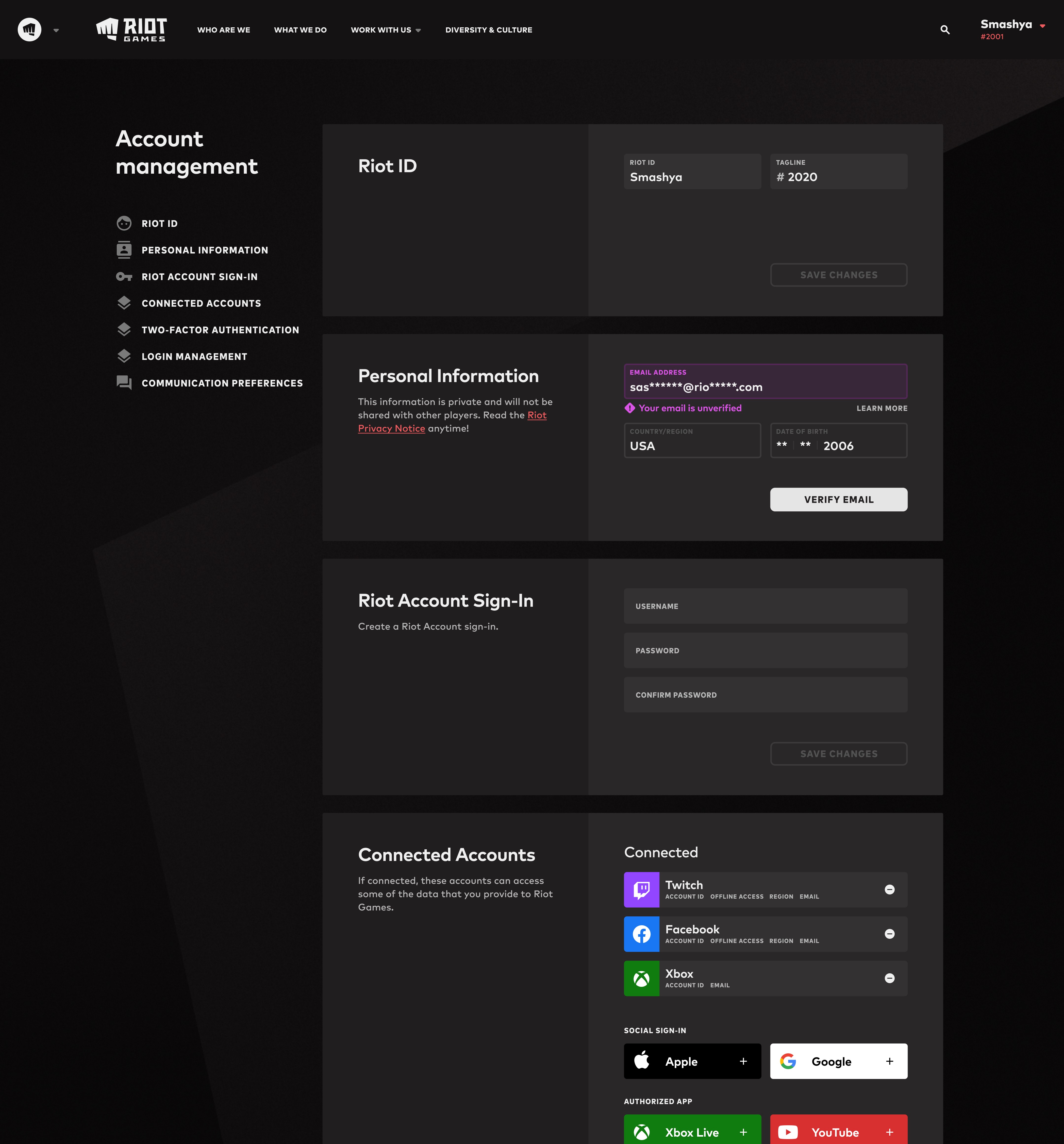
Account Management features were built vertically, a single page with every service being called whenever a user visited that page. This was due to lots of legacy code and became increasingly cumbersome.
While leading multiple projects, I ran into issues requiring a pivot to a less than ideal outcome.
The vertical structure was inefficient, expensive, and a headache for our engineers.
Features lacked any organization reflecting user goals.
The experience on mobile devices were odd and had usability issues.
Without addressing the core problem (overall architecture) we'd repeat the same frustrating cycle.
Redesigning the entire structure NOW, was a path to creating a net positive for both user goals and the business bottom line. It would reduces costs and unlock new feature capabilities.




This was a complicated project which required lots of organization and understanding what I could do without breaking live features or bloating scope.
Focusing on structural changes to improve scalability was a result of stakeholder alignment.
I mapped out functionality to understand how everything worked, where the challenges would come from, and how far things could be pushed now.
Through conversations I was able to drive additional regional alignment, bringing one unique stakeholder into the conversation, to reduce future engineering and design debt.
Weighing value-to-friction, a big UI overhaul was deemed out of scope for initial work.
To get a broad but targeted understanding that covered enough expectations, I did a full breakdown of specific competition to properly craft solutions for OUR users.
XBox/Microsoft
Playstation
Discord
Battlenet



Looking at the current experience a few things were clear, and outlining those allowed targeted fixes.
Menu dropdown caused usability issues.
The design reflected the current vertical build and would need to be overhauled to reflect the changes to organization.
Some UI shifted around when the menu state changed, which could create user confusion
There were incredible challenges to fully complete this project due to roadmap considerations, and the considerable engineering effort and cross team alignment required to deconstruct then rebuild the entire system. So any metrics currently lie in the data that drove the decisions.
Having already launched the internal developer system MVP focused on creating wide system scalability, I had unique insights into the value of tackling this redesign.
It's clear that once released this will be a mutually beneficial outcome to both player experiences and the company bottom line. Not only with usability and reduced API costs, but handling those will unlock the companies abilities to more efficiently build experiences that increase player value.
It also highlights the longer companies put off making their systems efficient and scalable, the more challenging and expensive that work becomes.